
When the data model matters
In structured-data applications, the data model keeps records, documents and metadata consistent with established standards and interoperable across systems.
Fore is designed for those applications: data-entry tools, editorial interfaces, metadata editors and standards-based forms where the model remains visible, reliable and central.
Structured data first
Work with XML and JSON as application data, not as an afterthought hidden behind component state.
Standards-based editing
Build editors for schema-based XML and JSON standards where validation, controlled vocabularies and domain-specific structures are central to the application.
Declarative rules
Express calculations, constraints, required fields and conditional relevance directly in the model.
Example: editing TEI person data
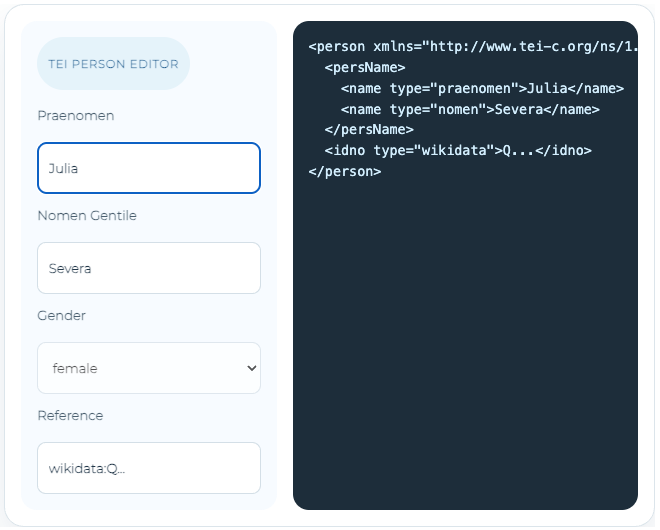
A Fore editor can expose the parts of a TEI model that matter for a specific domain — names, status, gender, references and controlled vocabularies — while editing the underlying XML directly.
The form is not a separate representation that later has to be transformed back into TEI. It works with the structured data model.
Where Fore fits
Fore is useful wherever applications need to edit, validate and exchange structured data without losing the semantics of the underlying model.
Digital humanities & Publishing
Editors for TEI, authority data, annotations and metadata, connected to structured publication and enrichment workflows.
Research & Science
Interfaces for structured data capture, curation and exchange, especially where standards and controlled vocabularies matter.
Public sector & Business
Forms and editors for eGovernment, health, finance, reporting and other processes built around regulated data.
How it works
Fore applications are written declaratively in HTML: data instances, bindings, controls and actions describe how the application behaves. Predefined actions cover common data operations such as setting values, inserting, deleting, updating and submitting data.
For project-specific logic, Fore can be extended with custom functions written in JavaScript, XPath or XQuery — without requiring a build process or bundling step.
Data instances
XML or JSON data remains the application model.
Bindings
XPath expressions define values, rules and dependencies.
Controls & actions
HTML controls edit the model; actions update, insert, delete or submit data.
Consistent UI
The interface reacts as calculations, validations and relevance change.
Declarative first, extensible when needed
Many applications can be built mostly — sometimes entirely — with Fore markup. When a project needs special logic, custom functions can be written in JavaScript, XPath or XQuery and used directly in bindings, calculations and actions.
Need a structured data editor?
Fore is developed by Jinntec. We provide consulting, prototypes, custom editors and support for projects built around XML, JSON, TEI, metadata and standards-based workflows.